

The Phone Isn’t the (only) Problem
On what young people actually need (because they said so)

SNL is at it’s best when it’s a little weird and absurd. Olivia Rodrigo’s episode last weekend gave us a delightful example in the short, “My Room.”
I mention it because last week, I ran my sixth and final workshop for the school year with students from Cristo Rey De La Salle High School in East Oakland.
I wanted them to reflect and map the spaces they inhabited during the past year of their lives. Where they went, what they made, who they were with, who they felt like themselves around.
Like Olivia Rodrigo, every single person named their bedroom.1
I’ve been sitting with that (and the bug people planet) ever since.
I’ve griped elsewhere about our dominant narrative and mental model about teenagers: they take risks, they’re influenced by peer pressure, all they want to do is socialize, etc. The Promise of Adolescence is a thicc2 reframe of these behaviors. If you’d rather not read the tome, The Center for the Developing Adolescent provides a nice, digestible summary of the “core science of adolescence.”
Over on Jonathan Haidt’s After Babel newsletter, Seth Kaplan, rightfully wonders what we’re replacing screen time3 with when all the bans go through. A quick aside on the phone bans: if we ban phones and don’t improve teaching and learning experiences to be more aligned with what kids are developmentally wired for (i.e., discovery, exploration, social experiences, contribution—aka the core science of adolescence) we shouldn’t expect anything to change. Way back in 2020, Jal Mehta and Sarah Fine charted the types of experiences that provided deeper learning for students. Spoiler: it was electives, extra curricular activities, and the like. Mostly not what happened between bells.
Kaplan picks up on the power of these extra curricular experiences—and suggests four steps to make groups and powerful relational experience core to youth lives:
Offer Proximity and Diversity
Give Youth Real Authority
Prioritize Experiences Over Instruction
Normalize Participation
And honestly, this list is what a pull string toy of me would say.…except that proximity to and diversity of experiences have always been unequally distributed in our country.
In last week’s workshop, I asked a second question: What did you want to do this year but couldn’t—or didn’t have a place for?
The answers weren’t dramatic. They weren’t even particularly surprising. They were just...honest.
Skateboard. Lock in on my grades. Go to the fair. Be proud of myself. Just hang out with the right people.
These were small, ordinary things. They didn’t require a platform, a strategic plan, or a theory of action. But they did require a place.
It’s worth noting, though, that the “Action” section of the reflection sheets (e.g., volunteering, civic participation) was consistently the least filled-in. I don’t necessarily see it as a failure, but it is a sequencing note. Any space has to feel safe before the civic imagination kicks in.
Kaplan points out:
A diversity of offerings in close proximity to one another increases participation and resilience. Libraries, schools, houses of worship, community centers, and even local businesses can host and sponsor groups.
What happens when those places aren’t there? Or aren’t accessible? Or aren’t youth-friendly?
There’s a concept I’ve mentioned before, courtesy of the Project for Public Spaces, called the Power of 10+. The idea is that people will linger and return when there are more than ten reasons to be in a space. High social infrastructure places (like the Rockridge neighborhood of Oakland) are exemplars of this, and all the shops, no matter how redundant4, are able to benefit.
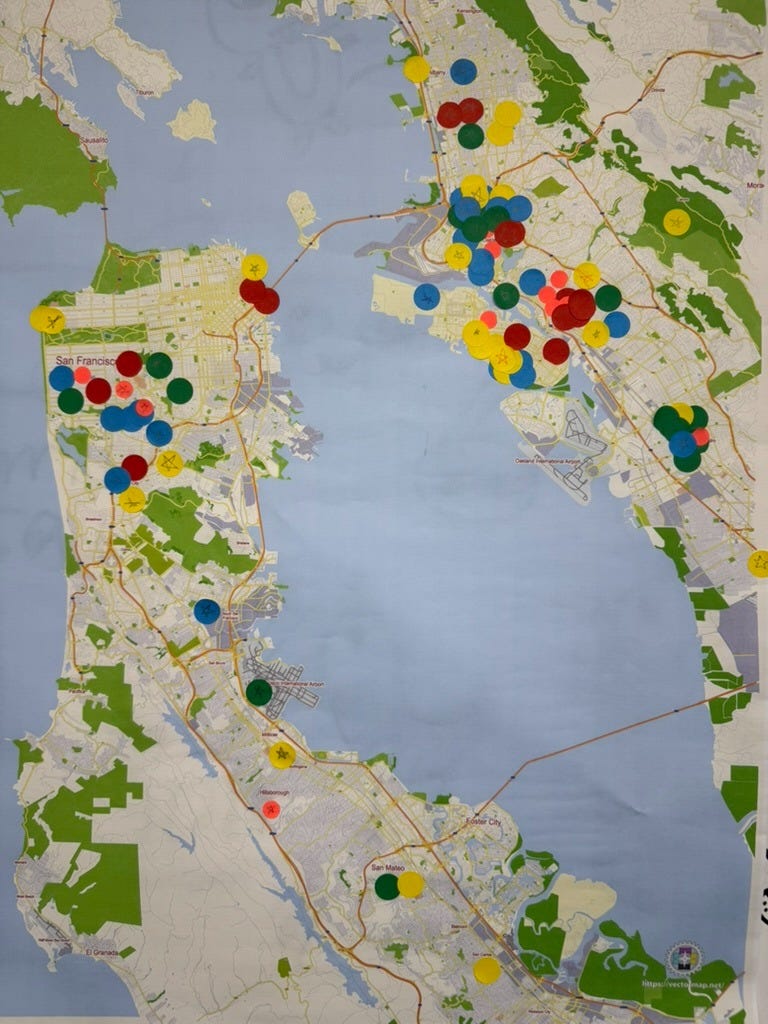
But what about for youth? How many of these spaces are welcoming or accessible to young people? In my neighborhood—with all of its many amenities—it’s only the library. And before you say, “but I see youth hanging out and doing homework at Hudson Bay and Ain’t Normal all the time,” can every youth afford to buy the drinks our financial advisors tell us not to buy? And what happens when the youth’s complexion is out of the neighborhood’s norm?
This is neither a Rockridge- nor Oakland-specific problem. Over in Australia, they’re having marginal success with banning social media access for teens. The authors of that study offered suggested reforms5 for Australia, that include subsidizing “free concert tickets, transit credits or discounts of various kinds” to incentivize less social media use.
Part of what they’re suggesting is funding youth social infrastructure. I’ve described some social infrastructure here in the form of third spaces, but we should also look at other youth-accessible, common spaces like public transit (e.g., student Metro cards) that raise all boats.6 Or even the all ages concert venue where characters were always hanging in The O.C.
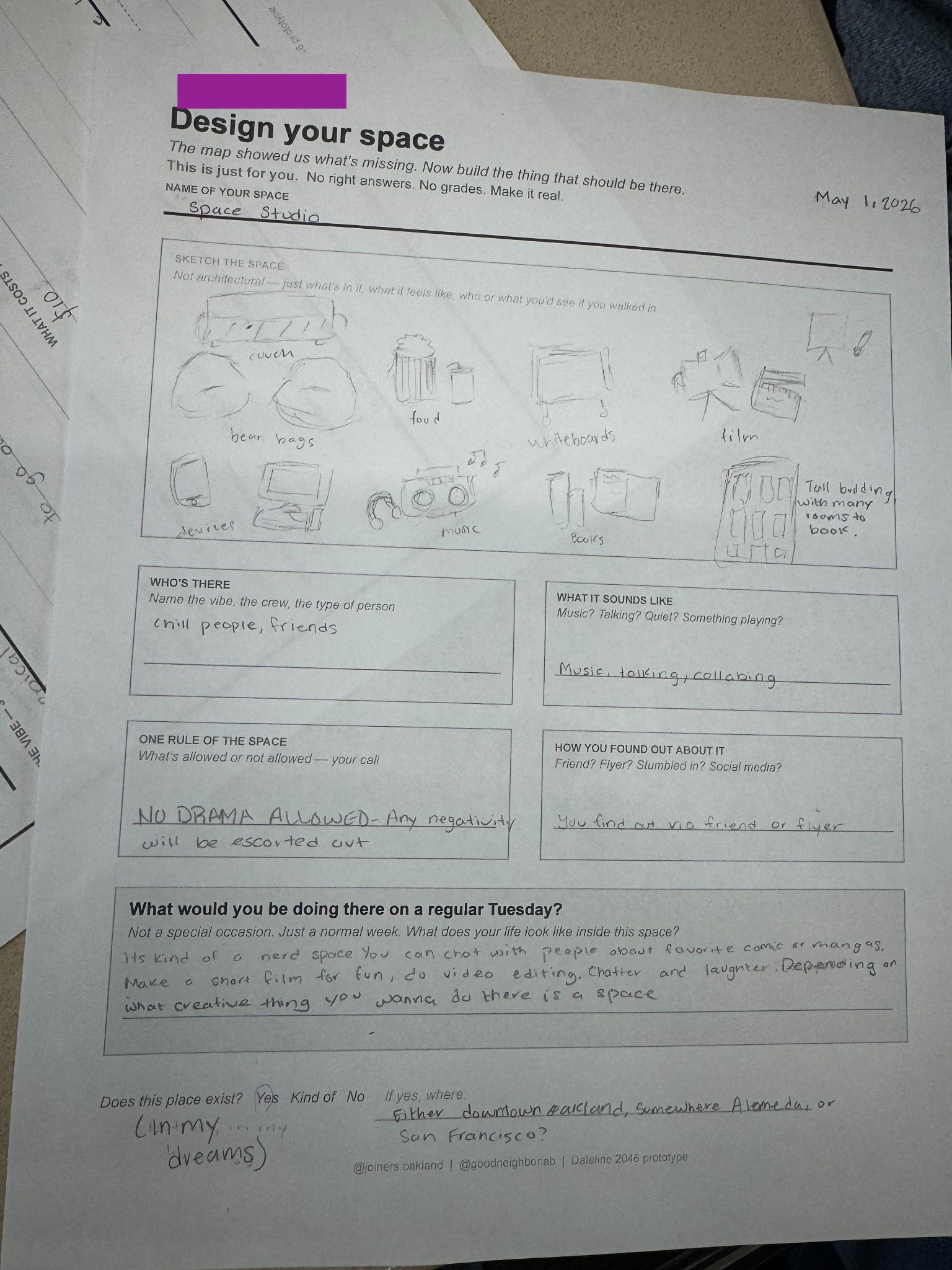
When we gave them the prompt, what the students designed for themselves wasn’t complicated. A cozy corner. A lake somewhere without a crowd. A room with games and food and no agenda. Governed by simple rules: be respectful, no drama. Free or close to it.
Three of the four groups proposed spaces that cost nothing or next to nothing. They weren’t asking for much. They were asking for permission to exist somewhere that wasn’t their bedroom.
Here’s what strikes me about this: neither the bedroom nor the phones are the problem. These are symptoms of a chronic disinvestment in the conditions that nurture healthy youth development.
The bedroom is what you get when other options aren’t welcoming. The phone is what you get when we let tech companies fill voids that were formerly filled by proximate experience and relationships. And the phone bans might be necessary, but they are woefully insufficient.
I’ve been thinking about the places (pre-cell phone ubiquity) where I felt the space to create and cultivate identities through my childhood and adolescence. I went to the library for homework. I went to the pool for swim practice (too much). Lots of DC and Maryland tweens just chilled in front of United Artists in Bethesda. I know some friends found their artistic selves at the Torpedo Factory or Roundhouse Theater. There were Girl and Boy Scouts in all-purpose rooms and church basements.
None of that was frictionless. But friction, it turns out, is part of how you meet people. How you figure out who you are outside of your own head.
The workshop I ran was a prototype—a play test for something bigger. This summer, as part of The Future of Us Festival in San Francisco, I’m joining forces with Julia Gitis and Good Neighbor Lab to run it again7. The premise is simple: what if we gave young people the tools to map what’s missing, imagine what should exist, and tell the story themselves?
We’re calling it Dateline 2046: Who Gets to Tell It.
More on that soon. But for now, I want to leave you with one thing one of the participants wrote when asked what they couldn’t do because the place was missing.
They—an otherwise quiet and withdrawn student—wrote that what they really wanted was somewhere they could lock in and be proud of themselves.
Not somewhere to perform. Somewhere to become.
We’re building toward that.
Events and Happenings:
May 9, Bay Delta Bioregional Unconference. Join doers and dreamers from across the Bay Delta Region to re-imagine a world that works for all life.
May 9, 7-9pm. Oakland Roots SC vs El Paso Locomotive FC. Support our hometown side, the Oakland Roots. Visit oaklandrootssc.com/fundraiser and use our code BEAJOINER to donate 20% of your ticket price to us.
May 10, 3pm. Oakland Soul Home Opener. Mother's Day special gets you a ticket, a flower, and a complementary drink. Tickets on Seat Geek.
May 11, 7pm. Lavender Pinball League Summer 2026 Kickoff Are you pinball-curious? Come check out an inclusive, beginner-friendly pinball league for queer people and their allies! This Monday listing is their kickoff date, but there are weekly meetups on Monday nights alternating between SF (Emporium, Detour) and Oakland (Beeryland/Legionnaire, Hesher’s Pizza). More info on IG.
May 15, 5-11pm. Revival Rounds: OMCA + DREXL. Revival Rounds is back. We’ll enjoy some Afro-Colombian dance and psychedlic cumbia at OMCA (kid friendly) and then head to DREXL to continue. RSVP on Luma or Partiful.
May 16. 5-7pm. Oakland Roots SC vs Sacramento Republic FC. Support our hometown side, the Oakland Roots. Visit oaklandrootssc.com/fundraiser and use our code BEAJOINER to donate 20% of your ticket price to us.
May 19. 7-10pm. Prints and Pints. Make and print linocuts with Rock Paper Scissor Collective over a cold one and a burger from Lovely’s. Rock Paper Scissors will have supplies for use including carving tools, ink pads, and paper. Carving blocks will be available by donation.
July 4-12. The Future of Us Festival. A weeklong celebration of civic imagination in San Francisco. There will be dozens of incredible activations across the city (I know because JOINERS will have one).
Not because they wanted to be there. Because there wasn’t anywhere else that felt like theirs.
Like 500 pages.
NB: I haven’t read The Anxious Generation, and I think our language should reflect the research rather than the vibes. Here’s a nice debate between Haidt and UC Irvine’s Candice Odgers on the research.
Dear Reader: why do I have two record stores across the street from each other? Four vintage shops in a 10-minute walk? Probably around 7–8 grocery stores in under a mile?
I’d probably add that they need to follow the Truth Campaign more closely and paint social media companies as extractive bad actors worth rebelling against.
Yes, students with financial hardship benefit, but so does every other student. Or (wonkily) this is targeted universalism.
If you work with young people, run a space, or want to get involved in July, reach out. There might be a seat at the table.
Well, Jared, the old adage rings true: the more things change the more they stay the same. Many years ago I founded a youth group in San Francisco called Y-MAC (Youth Making A Change). This was way, way before smart phones. When they had the opportunity to create their first campaign. it focused on creating spaces for young people --- places to go, things to do. It is a timeless issue. Thanks for listening to young people and supporting efforts to respond to their real, self-identified needs.